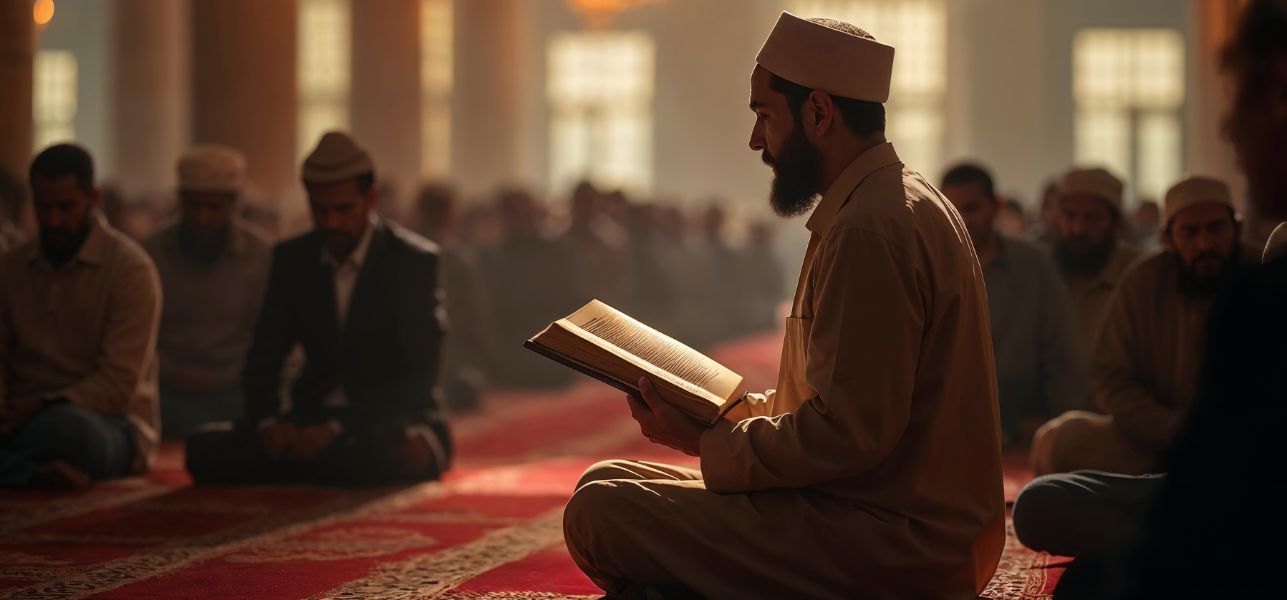
Taqwa (God-consciousness) in the Qur’an is not a marginal virtue, nor a fleeting spiritual state. Rather, it is the central axis around which the entire divine message revolves. It is the ultimate goal of Qur’anic guidance, the intended outcome of all acts of worship, and the true measure of success in human life culminating in the greatest reward prepared by God for the believers who attain it.
From the very beginning of revelation, the Qur’an sets the direction clearly not merely addressing details of belief and practice, but defining the final مقصد (purpose) of the human journey:
“That is the Book in which there is no doubt, a guidance for the muttaqīn (the God-conscious).”
(Qur’an 2:2)
The Qur’an is guidance, but guidance itself is not an end in isolation. It is a means leading toward something higher: becoming among the people of taqwa.
First: Taqwa as the Goal of Qur’anic Guidance
The Qur’an was not revealed to be a cultural artifact, a text for argumentation, or a decorative recitation. It was revealed to form a God-conscious human being. That is why the Qur’an does not say “guidance for all people” in terms of effect, but rather guidance for the muttaqīn those with hearts receptive to truth.
The muttaqīn are those who:
seek truth, not victory in debate,
read the Qur’an to be guided, not to justify preconceived positions,
submit to revelation even when it challenges personal interests.
Thus, taqwa is both the condition for benefiting from guidance and its ultimate fruit.
Second: Taqwa as the Purpose of All Acts of Worship
No act of worship in Islam was legislated except to cultivate taqwa—explicitly or implicitly.
Fasting:
“O you who believe, fasting has been prescribed for you as it was prescribed for those before you, so that you may attain taqwa.”
(Qur’an 2:183)
Pilgrimage (Hajj):
“And take provision, but indeed the best provision is taqwa.”
(Qur’an 2:197)
Ritual sacrifice and outward acts:
“Their meat and their blood do not reach Allah, but what reaches Him is taqwa from you.”
(Qur’an 22:37)
Worship, therefore, is not an end in itself. It is a training ground for taqwa—for cultivating awareness of God in decisions, behaviors, and inner states. Any worship that does not increase honesty, restraint, justice, and moral responsibility has missed its highest purpose.
Third: Taqwa as the Meaning and Measure of Human Life
The Qur’an decisively defines the true criterion of human worth:
“Indeed, the most honored of you in the sight of Allah is the one with the greatest taqwa.”
(Qur’an 49:13)
Success in life, from the Qur’anic perspective, is not measured by longevity, wealth, achievement, power, or recognition, but by how much taqwa a person carries to the end of their journey.
Taqwa means:
living with awareness of God’s presence,
choosing truth when options are many,
upholding justice even when injustice is easier,
repenting and reforming after failure rather than persisting in error.
Life, then, is one extended examination, and those who pass are those who emerge from it with taqwa.
Fourth: The Supreme Reward Prepared for the Muttaqīn
When the journey reaches its conclusion, the Qur’an presents a recurring and emphatic promise—introduced repeatedly with the strong form “Indeed” (inna):
“Indeed, the muttaqīn will be in gardens and springs.” (51:15)
“Indeed, the muttaqīn will be in gardens and bliss.” (52:17)
“Indeed, the muttaqīn will be in gardens and a river.” (54:54)
“Indeed, the muttaqīn will be in shade and springs.” (77:41)
Yet the reward does not stop at material delight. Its climax is expressed in one profound verse:
“In a seat of truth, in the presence of a Sovereign, All-Powerful.”
(Qur’an 54:55)
This is the ultimate prize:
nearness to God,
peace without fear,
honor without humiliation,
permanence without loss.
It is the greatest success, beyond all worldly achievements.
Conclusion: A Call to the Hearts — Before the Days Pass
O people of the Qur’an,
The days are passing with alarming speed. Life slips away like a fleeting glance, and what once felt long now seems unimaginably short:
“On the Day they see it, it will seem as though they had remained only an evening or its morning.”
Between birth and death lies one single opportunity either to live for God or to be lost in heedlessness and delay.
The Qur’an was revealed as guidance for the muttaqīn not to be recited without reflection, nor memorized without transformation, but to become a scale by which life is weighed and directed. The greatest loss is to read it and remain unchanged, to hear it and fail to hold our lives accountable by it.
Let us, then, reflect deeply upon the Qur’an, knowing that time is short.
Let us make taqwa our goal in this world:
in our intentions,
in our choices,
in our public actions and private moments,
in times of strength as well as weakness.
And let taqwa also be our goal for the Hereafter, for beyond death lies only accountability, and salvation belongs solely to those who come to God with hearts shaped by taqwa.
“Be mindful of Allah and know that Allah is with the muttaqīn.”
“Indeed, the muttaqīn are in gardens and bliss.”
Blessed, then, are those who make taqwa their path,
the Qur’an their guide,
the Hereafter their destination,
and the pleasure of Allah their ultimate aspiration.
O Allah, make us among the muttaqīn, and do not make us among the heedless.