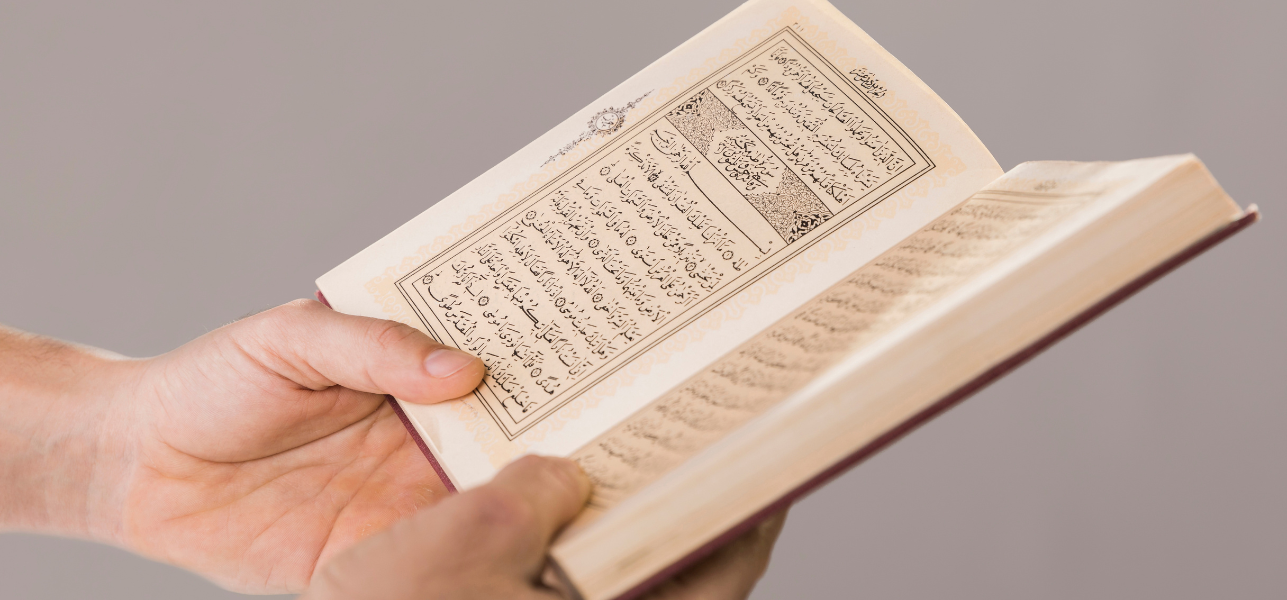
The Qur’an presents one of the most profound distinctions ever made about reality:
“Unquestionably, His is the creation (khalq) and the command (amr).” (7:54)
This verse is often read as a simple statement that God creates and governs. Yet it points to something much deeper. It suggests that reality itself has two inseparable dimensions: the created medium through which things exist and the organizing command through which they acquire form, meaning, function, and purpose.
The first dimension is khalq. The second is amr.
Understanding their relationship provides a unified framework for reading the Qur’an, understanding nature, and explaining humanity’s unique role in creation.
Khalq: The Material Dimension of Reality
Khalq is everything that can be observed, measured, weighed, or analyzed.
Matter is khalq.
Atoms are khalq.
Molecules are khalq.
Stars, planets, mountains, rivers, cells, and bodies are khalq.
Historical events and physical processes are khalq.
Khalq is the medium through which reality is manifested.
Modern science has become extraordinarily successful in studying khalq. It can analyze the chemical composition of a cell, identify the structure of DNA, measure the movement of galaxies, and trace the causes of historical events. Yet none of these achievements fully explain why matter is organized the way it is.
Science can describe the medium. It cannot derive meaning from the medium itself.
For that, we must turn to amr.
Amr: The Organizing Principle
Amr is not merely a command spoken by God.
It is the organizing principle that gives form, structure, and direction to creation.
It is meaning expressed through matter.
It is information embodied in physical form.
It is the formula, code, pattern, and guidance through which creation becomes intelligible.
The difference can be illustrated through writing.
Ink on a page is khalq.
The meaning conveyed by the arrangement of the ink is amr.
The physical substance alone does not explain the message. The message emerges from how the substance has been organized.
The same principle appears throughout creation.
Matter is the medium.
Amr is the message.
DNA: The Clearest Modern Example
No discovery illustrates this distinction more clearly than DNA.
Every living organism is built from the same four molecular letters: A, T, C, and G.
The alphabet is universal.
A tree uses the same alphabet.
A bird uses the same alphabet.
A human being uses the same alphabet.
The molecules themselves are not what make these creatures different.
Their organization does.
The same four letters arranged in one sequence produce an oak tree.
Arranged in another sequence, they produce a whale.
Arranged in yet another sequence, they produce a human being capable of thought, language, and moral responsibility.
The molecular letters are khalq.
The sequence that organizes them is amr.
The physical material remains essentially the same, while the information encoded within that material generates entirely different forms of life.
This distinction reveals a profound truth: information cannot be reduced to the substance that carries it.
The medium is not the message.
The molecules do not explain the code.
The code directs the molecules.
The Universe is Filled with Amr and the Qur’an call them Sunan
What is true of DNA is true of reality itself.
The laws of physics are amr expressed through matter.
The mathematical order of the cosmos is amr expressed through matter.
The developmental instructions that transform a fertilized cell into a human being are amr expressed through matter.
The recurring patterns governing the rise and fall of civilizations are amr expressed through history.
Everywhere we look, we find physical media carrying nonphysical information.
Creation is never merely substance.
It is substance organized according to a pattern.
That pattern is what the Qur’an calls Sunan or unchanging patterns and they are based on amr (command from The Creator).
The Human Being as Reader
The Qur’an teaches that the human being occupies a unique position within creation.
Unlike other creatures, humans can perceive both dimensions of reality.
We can observe khalq.
We can also seek to understand amr.
A scientist reading DNA is searching for amr within khalq.
A historian searching for patterns in civilization is searching for amr within khalq.
A believer reflecting on revelation is searching for amr within language.
In each case, the activity is fundamentally the same: reading meaning embedded within a medium.
This is why the first revelation began not with a creed or a commandment, but with a command to read.
“Read in the name of your Lord who created.” (96:1)
The object of reading is not the Qur’an alone.
It is the entirety of creation.
The Universe as a Text
The Qur’an repeatedly describes natural phenomena as āyāt, signs.
A sign is never an end in itself.
A sign points beyond itself to meaning.
When the Qur’an calls the heavens, the earth, history, and the human self āyāt, it is describing reality as a form of communication.
The universe is therefore not merely an object.
It is a text.
A text has symbols.
A text carries information.
A text communicates meaning.
A text has an author.
The Qur’an is a text written in words.
The universe is a text written in matter.
The human being is a text written in biology and consciousness.
All three are composed of khalq carrying amr.
All three originate from the same Author.
A New Way of Understanding Reality
The distinction between khalq and amr offers a bridge between science and faith.
Science studies the medium.
Faith seeks the meaning.
Science examines the letters.
Faith asks about the message.
Science investigates khalq.
Faith seeks to understand amr.
Neither is complete without the other.
The Qur’anic vision is therefore not a conflict between science and religion but a partnership between two ways of reading the same reality.
One studies the structure.
The other seeks its significance.
One observes creation.
The other discerns command.
Together they reveal the fullness of God’s communication.
Conclusion
The central claim of this article is simple:
Reality consists of khalq and amr.
Khalq is the created medium: matter, energy, molecules, bodies, events, and structures.
Amr is the organizing information: meaning, formula, code, pattern, guidance, and purpose.
DNA provides a striking example. The same molecular alphabet can produce countless forms of life because information organizes matter into different expressions of creation. The molecules are khalq; the code is amr.
The entire universe operates according to this principle. Everywhere there is a medium, there is a message. Everywhere there is creation, there is command. The human being, endowed with Rūḥ, (Q 15:29) has been given the unique ability to read both.
To understand the world, therefore, is not merely to study what things are made of. It is to discover what they are saying.
That is the deeper meaning of the Qur’an’s first command:
Read.